
Peptide research has expanded considerably over the past two decades, and one area that is interesting from a research perspective is hormonal biology and women’s health.
Hormonal shifts characterise different stages of a woman’s life and do not affect a single biological system in isolation.
Collagen metabolism, connective tissue integrity, sleep regulation, stress physiology, and neurotrophic signalling (the biological processes that support neuronal growth and maintenance) are all influenced by the same underlying hormonal environment, and all represent areas where peptide science is generating meaningful research questions.
The focus in women’s health research remains on mechanism and pathway, which provides the subject of ongoing and in many cases early-stage investigation.
To understand why women’s health peptide research has become its own field rather than a subset of general peptide science, it helps to understand what makes the hormonal biology of women distinctive from a research perspective.
Oestrogen, progesterone, and the hormones that regulate their production interact with collagen synthesis pathways, influence the integrity of connective tissue, modulate the stress response via the hypothalamic-pituitary-adrenal axis (the hormonal feedback system through which the brain regulates the body’s response to stress), affect sleep, and play a role in the regulation of neurotrophic factors including BDNF (brain-derived neurotrophic factor, a protein central to the maintenance and adaptation of neurons).
This is greater than simply affecting the reproductive system.
When these hormones shift, as they do progressively from the mid-thirties onward, the downstream effects ripple across multiple systems simultaneously.
This is what makes the research context for women’s health inherently multisystemic.
Two peptides are most frequently referenced in research examining skin biology and connective tissue pathways in the context of hormonal change.
GHK-Cu is a naturally occurring copper-binding tripeptide (a chain of three amino acids with a natural affinity for copper ions) that declines in concentration with age.
Research has investigated GHK-Cu in relation to collagen synthesis, extracellular matrix remodelling (the ongoing reorganisation of the structural protein network underlying skin and connective tissue), antioxidant pathway regulation, and gene expression patterns associated with tissue repair.
A 2023 study published investigated the relationship between GHK-Cu and collagen IV, a structural protein involved in anchoring the layers of skin together.
The study identified associations between GHK-Cu and collagen IV synthesis, contributing to the body of evidence examining this peptide’s role in skin biology.
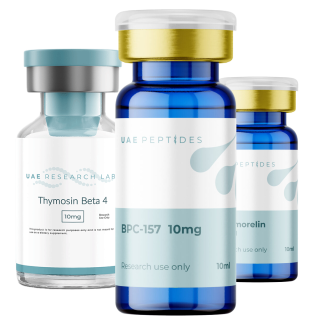
BPC-157 is a synthetic pentadecapeptide (a fifteen-amino-acid chain) derived from a partial sequence found in gastric juice.
Research into BPC-157 has examined its role in tendon and ligament repair signalling, angiogenesis (the formation of new blood vessels that support tissue healing), and gastrointestinal mucosal repair pathways.
A study was published that examined BPC-157 in the context of muscle-to-bone reattachment research, investigating the cellular and molecular mechanisms involved in musculoskeletal tissue repair following injury.
→ You can read that study here
Cellular ageing research examines the molecular mechanisms through which biological function changes over time.
Within the context of women’s health, this research intersects with neuroendocrine biology (the study of how the nervous system and the hormonal system interact) and circadian regulation (the body’s internal 24-hour biological clock).
Epitalon is a synthetic tetrapeptide (a four-amino-acid chain) that has been studied in relation to telomerase activity (the enzyme involved in maintaining telomere length, where telomeres are the protective caps on the ends of chromosomes that shorten with each cell division), pineal gland function, and melatonin regulation.
The pineal gland governs the circadian release of melatonin, which in turn influences sleep architecture and broader neuroendocrine signalling.
A 2022 study investigated Epitalon in the context of reproductive cell ageing, examining markers of oxidative stress (the accumulation of unstable reactive molecules that contribute to cellular damage) and indicators of cellular function.
The study identified associations between Epitalon and reductions in oxidative stress markers, alongside changes in cellular function indicators.
The relationship between hormonal change, stress physiology, and cognitive function is a growing focus of peptide research in women’s health.
Sustained activation of the stress response pathway is associated with suppression of BDNF activity (brain-derived neurotrophic factor, a protein that supports neuronal growth, survival, and the maintenance of synaptic connections), which links stress biology directly to cognitive and neurotrophic research.
Selank is a synthetic heptapeptide (a seven-amino-acid chain) developed from the endogenous peptide tuftsin.
Research has examined its interactions with GABAergic pathways (the signalling systems regulated by GABA, the brain’s primary inhibitory neurotransmitter that plays a central role in modulating the stress response and anxiety) and downstream effects on cognitive parameters.
Vyunova et al., examined the molecular mechanism of Selank’s anxiolytic (anxiety-reducing) activity.
The researchers identified that Selank interacts with GABA receptor pathways through a mechanism distinct from conventional benzodiazepine drugs, producing prolonged anxiolytic and nootropic effects without the dependency profile associated with standard pharmacological options in this class.
Semax is a synthetic heptapeptide derived from the N-terminal fragment of ACTH (adrenocorticotropic hormone, which plays a central role in the body’s hormonal stress response).
Research has examined its relationship to BDNF and NGF (nerve growth factor, a protein that supports the survival and maintenance of specific neuronal populations), as well as its neuroprotective properties in preclinical models of neurological strain.
A 2021 study investigated Semax’s effects on brain protein expression in an animal model of ischemia-reperfusion injury (a research model used to study the cellular effects of reduced blood flow followed by its restoration).
The study found associations between Semax exposure and proteins involved in neuroprotection and neuronal survival pathways.
Peptide research can be difficult to navigate for anyone without a scientific background, and it is worth understanding a few principles that help contextualise what the studies in this space are and are not saying.
Most of the studies referenced in this area were conducted in cell culture or animal models.
This is a standard and necessary stage of scientific investigation. It means findings are early-stage, not that they are without value.
Research demonstrating that a peptide interacts with a particular biological pathway does not automatically mean a specific outcome will follow in a human context.
The pathway research informs what questions are worth asking next.
Hormonal profiles, genetic factors, lifestyle, and health history all influence how any compound interacts with a given biological system.
What is true in a study population is a starting point, not a prediction for any individual.
Research-stage compounds should always be approached with qualified oversight. The complexity of the systems involved, and the early-stage nature of much of the evidence, makes professional consultation an essential component of any responsible engagement with this research.
Understanding the breadth of the peptide research landscape can feel overwhelming.
The UAE Peptides team offers one-to-one consultation calls with our Peptide Therapy specialists who can help you navigate the research and understand what is relevant to your interests.
Schedule your consultation today
The hormones central to women’s physiology interact with a wide range of biological pathways beyond the reproductive system, including collagen metabolism, connective tissue integrity, stress response regulation, and neurotrophic signalling. Shifts in these hormones across different life stages create a distinctive biological context that makes the study of targeted compounds like peptides particularly relevant for understanding how these systems change over time.
A pathway refers to the specific biological mechanism through which a compound interacts with the body at a molecular or cellular level, such as how a peptide influences collagen synthesis signalling or BDNF expression. An outcome refers to a measurable change in health or function that results from that interaction. Pathway research is generally an earlier stage and more mechanistic, while outcome research requires clinical investigation in human populations.
Each of these peptides is studied in relation to a biological system that is known to be influenced by the hormonal changes associated with ageing in women. Skin biology, connective tissue integrity, cellular ageing, stress response modulation, and neurotrophic signalling are all interconnected systems that shift as part of the same broader hormonal environment, which is why research into these compounds tends to cluster around this biological context.
The evidence base varies by compound and by research area. Some peptides, such as GHK-Cu and BPC-157, have a more extensive preclinical literature than others. Much of the research across all five compounds remains preclinical or early-stage, meaning it has been generated in cell culture or animal models. This does not diminish the scientific value of the findings, but it does mean that the translation to human applications requires careful consideration and ongoing clinical investigation.
When researchers say a peptide interacts with a pathway, they mean it engages with a specific sequence of molecular events within a cell or tissue. This could involve binding to a receptor, influencing gene expression, modulating enzyme activity, or affecting the production of a particular protein. The study of these interactions is how researchers build an understanding of what a compound does at a biological level and what questions are worth investigating further.
The biological systems these peptides are studied in relation to are interconnected, which means there is scientific rationale for studying combinations. Whether doing so is appropriate in any specific research context depends on the pathways involved, the compounds being considered, and the individual biological profile of the person involved. This is an area where professional guidance is particularly important.
Written by Elizabeth Sogeke, BSc Genetics, MPH
Elizabeth is a science and medical writer specialising in peptide science, longevity medicine, mitochondrial health, metabolic optimisation and regenerative health research. With a BSc in Genetics and a Master’s in Public Health, she combines a strong scientific foundation with experience translating complex biomedical research into clear, clinically informed education for the Peptide Therapy and longevity medicine space. Her work is centred on interpreting emerging peptide, metabolic and longevity research with scientific accuracy, clinical awareness and a clear understanding of how these therapies are being discussed and applied in modern health optimisation.
Discount Applied Successfully!
Your savings have been added to the cart.

20% OFF sitewide across
UAE Peptides for a limited time
Use the promocode: SITEWIDE20